

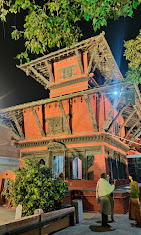
Nepali Temple
Shri Samrajeswar Pashupatinath Mahadev Mandir, also known as the Nepali Mandir (Hindi: नेपाली मंदिर), Kanthwala Mandir and Mini Khajuraho (Kanthwala in Hindi means wooden), is one of the oldest and most famous temples in the holy city of Varanasi. This temple has great religious importance in Hinduism and is dedicated to the Lord Shiva. Constructed in the 19th century A.D by the King of Nepal, the temple is made of terracotta, stone and wood and is replica of the Pashupatinath Temple in Kathmandu.[1][2][3][4][5] History Rana Bahadur Shah, King of Nepal The King of Nepal, Rana Bahadur Shah took exile in Varanasi from 1800 to 1804 and titled himself as “Swami Nirgunanda”. During his exile, he decided to build a replica of Pashupatinath Temple in Varanasi. Construction of the temple commenced during his exile / stay in Varanasi. During the construction, Shah moved back to Nepal. On 25 April 1806, Rana Bahadur Shah was stabbed to death by his stepbrother, Sher Bahadur Shah. His son Girvan Yuddha completed the project 20 years after the deadline. The land was later transferred to Rana Bahadur Shah by Kashi Naresh in the year 1843. The temple, adjacent area, Lalita Ghat and a dharamshala, belongs to the Nepal government.[1][2][3][4][5]
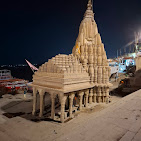
Manikarnika Ghat
Manikarnika Ghat (Hindi: मणिकर्णिका घाट) is one of the holiest[1] cremation grounds among the sacred riverfronts (ghats), located on the banks of River Ganges, in the city of Varanasi in the Indian state of Uttar Pradesh. In Hinduism, death is considered a gateway to another life marked by the result of one’s karma. It is believed that a human’s soul attains moksha, and hence breaks the cycle of rebirth when cremated here.[2] The ghat is named after the earrings of Sati, a Hindu goddess, which Hindus believe fell there.[3] The Hindu genealogy registers at Varanasi are kept there.
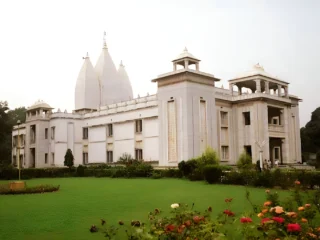
Shri Satyanarayan Tulsi Manas Mandir, Varanasi
Tulsi Manas Mandir (Hindi: तुलसी मानस मंदिर) is one of the most famous temples in the holy city of Varanasi. This temple has great historical and cultural importance in Hinduism since the ancient Hindu epic Ramcharitmanas was originally written at this place by Hindu poet-saint, reformer and philosopher Goswami Tulsidas in the 16th century (c. 1532–1623).[1][2]
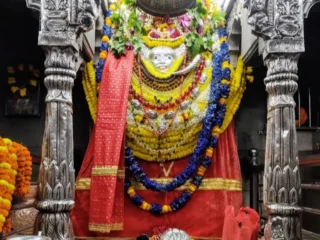
Kaal Bhairav Temple
Kaal Bhairav Mandir (Hindi: काल भैरव मंदिर) is one of the oldest Shiva temples in Varanasi, India. Situated in Bharonath, Vishweshwarganj (Varanasi), this temple has great historical and cultural importance in Hinduism; especially amongst the locals. The temple is dedicated to Bhairava (Kaal Bhairav), a fierce form of Shiva and wears a garland of skulls and carries a club of peacock feathers. The word “Kaal” means both “death” and “time”. Kaal Bhairav also means the one who removes the fear of both death and time. It is believed that even death is afraid of Kaal Bhairav. Housed in the inner sanctum of the temple is a silver faced idol of Kal Bhairav who is seated on his vahana (vehicle), a dog and is holding a trident. Only the face of the icon decorated (with garlands) is visible to the visitors through the doorway. Rest of the icon is covered with a piece of cloth. On the rear door of the temple, there is an icon of Kshetrapal Bhairav, another aspect of Bhairava.[2][3][4]
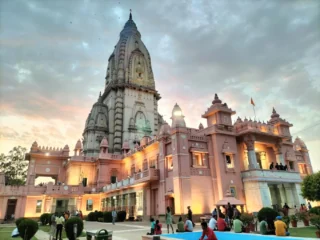
Shri Kashi Vishwanath Temple
Kashi Vishwanath Temple is a Hindu temple dedicated to Shiva. It is located in Vishwanath Gali, in Varanasi, Uttar Pradesh, India. The temple is a Hindu pilgrimage site and is one of the twelve Jyotirlinga shrines. The presiding deity is known by the names Vishwanath and Vishweshwara (IAST: Viśvanātha and Viśveśvara), meaning Lord of the Universe. The original temple, called the Adi Vishveshwar Temple, was demolished by Mohammad of Ghor during his invasion of India. Subsequently, the template was rebuilt by Man Singh I and Todar Mal under the emperor Akbar. According to several historical accounts, the Mughal Emperor Aurangzeb ordered the demolition of the Hindu temple in 1669.[1] Subsequently, in 1678, the Gyanvapi Mosque was built on its site,[2] but Hindu pilgrims continued to visit the remnants of the temple.[1] The current structure was constructed on an adjacent site by the Maratha ruler Ahilyabai Holkar of Indore in 1780.[3]